
NOCSAE Testing Explained: What the Severity Index Means for Buyers
If you've shopped for helmets or any kind of head protection in baseball, you've probably seen the term NOCSAE on products or in a product description. It gets used a lot, but is not a familiar term to most. Here's what it means, in plain terms, how the test works, and why it matters when you're deciding what to buy for a pitcher, an infielder, a youth player, a base coach or a field umpire.
What Is NOCSAE?
NOCSAE stands for the National Operating Committee on Standards for Athletic Equipment. The committee writes standards for athletic equipment for the purpose of reducing the risk of injuries. NOCSAE doesn't manufacture helmets or head protection products itself. It sets the testing process a product has to pass, and independent labs run that test on submitted products.
When a product claims it's designed to pass NOCSAE testing, or that it was tested at a NOCSAE-certified lab, it means the product was run through a defined impact test with a numeric pass or fail result attached to it.
How a NOCSAE Impact Test is Measured for a Baseball Pitcher's Protective Insert: The Severity Index
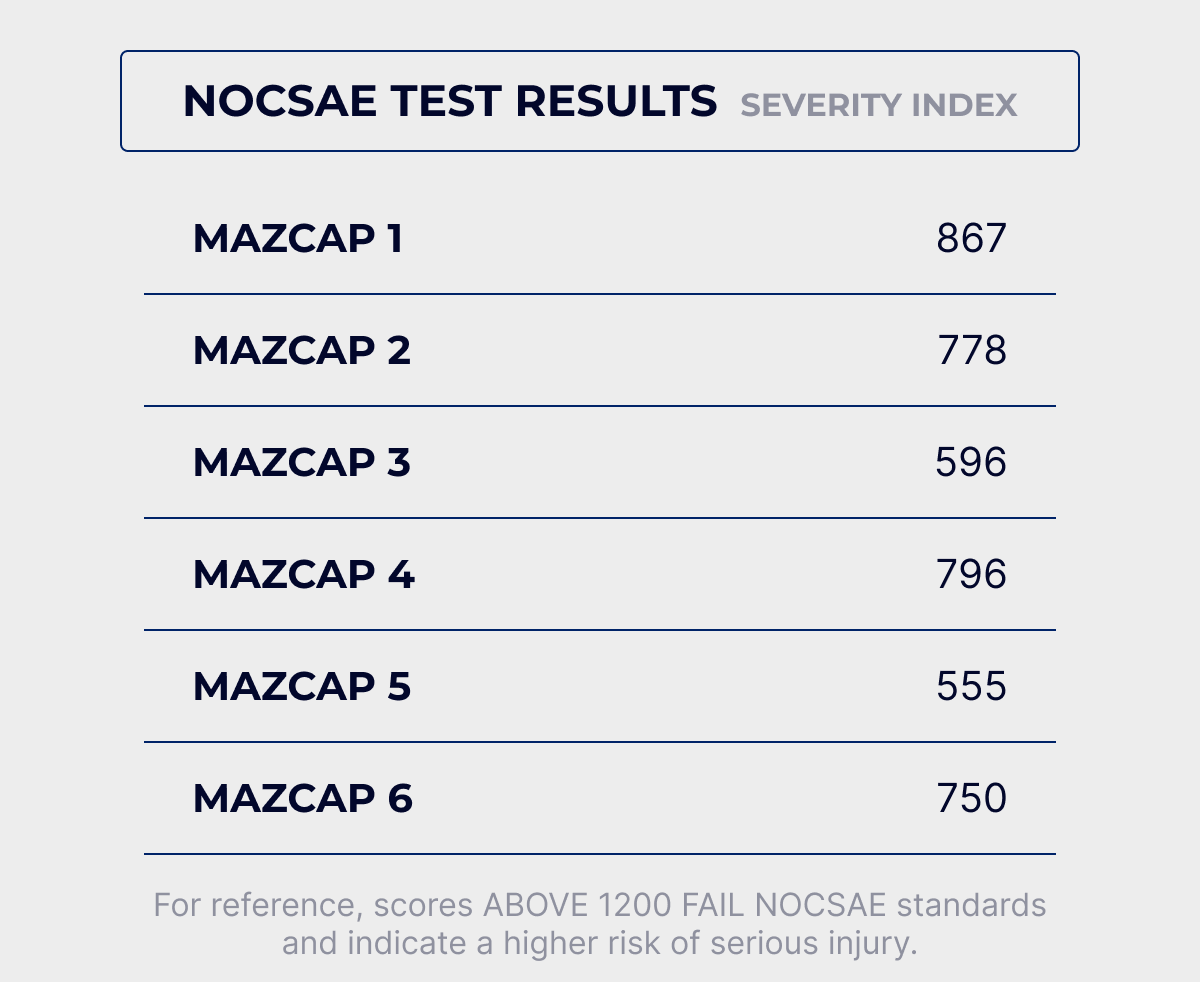
A baseball is propelled at a computerized head form for impact testing purposes. A MAZCAP is impacted with a baseball on the Front, Front-Boss, and Side NOCSAE head form test locations. Each NOCSAE impact test produces a number called the Severity Index, or SI. SI is a measure of impact severity. Below 1200 SI is a passing score while anything above 1200 is a failing score and indicative of the potential for catastrophic head injury.
Here's the short version of how it's calculated. During testing, an instrumented head form is struck, and sensors record the head form's acceleration resulting from the baseball impact. That impact typically lasts somewhere around 8 to 10 milliseconds from start to finish.
The Severity Index is calculated as the integral of the measured head acceleration raised to the power of 2.5. The result is one score that can be compared against a fixed pass/fail threshold, the same way every time.
NOCSAE Pass or Fail: Where the Line Is
In order to pass the NOCSAE test, the helmet or safety device must score a Severity Index of less than 1200. 1200 SI is a pass/fail threshold and scores above 1200 SI fail the test and represent a high risk of significant head injury.
The NOCSAE pass/fail threshold is valuable for evaluating products. It's common to look at a product that passes NOCSAE testing as a product that offers meaningful risk reduction and significantly better protection than a product that does not pass a NOCSAE test. The NOCSAE test offers a basis for comparing products. In testing done for comparison, bump caps, foam plates, and thin hat inserts, the kind of products sometimes suggested for head protection in baseball, scored above 5,000 SI, and some scored above 10,000. That's roughly 5 to 10 times worse than the NOCSAE threshold, not a marginal miss. A product that exceeds NOCSAE test criteria by that margin doesn't offer meaningful risk reduction compared to a product that passes the NOCSAE test criteria, regardless of how it looks or feels.
MAZCAP is designed to pass NOCSAE impact testing for the Front, Front-Boss, and Side locations. The first commercially produced MAZCAPs were tested at an independent, third-party NOCSAE-certified lab, and all versions passed impact testing. A table showing the side impact test results at ambient conditions is provided below:
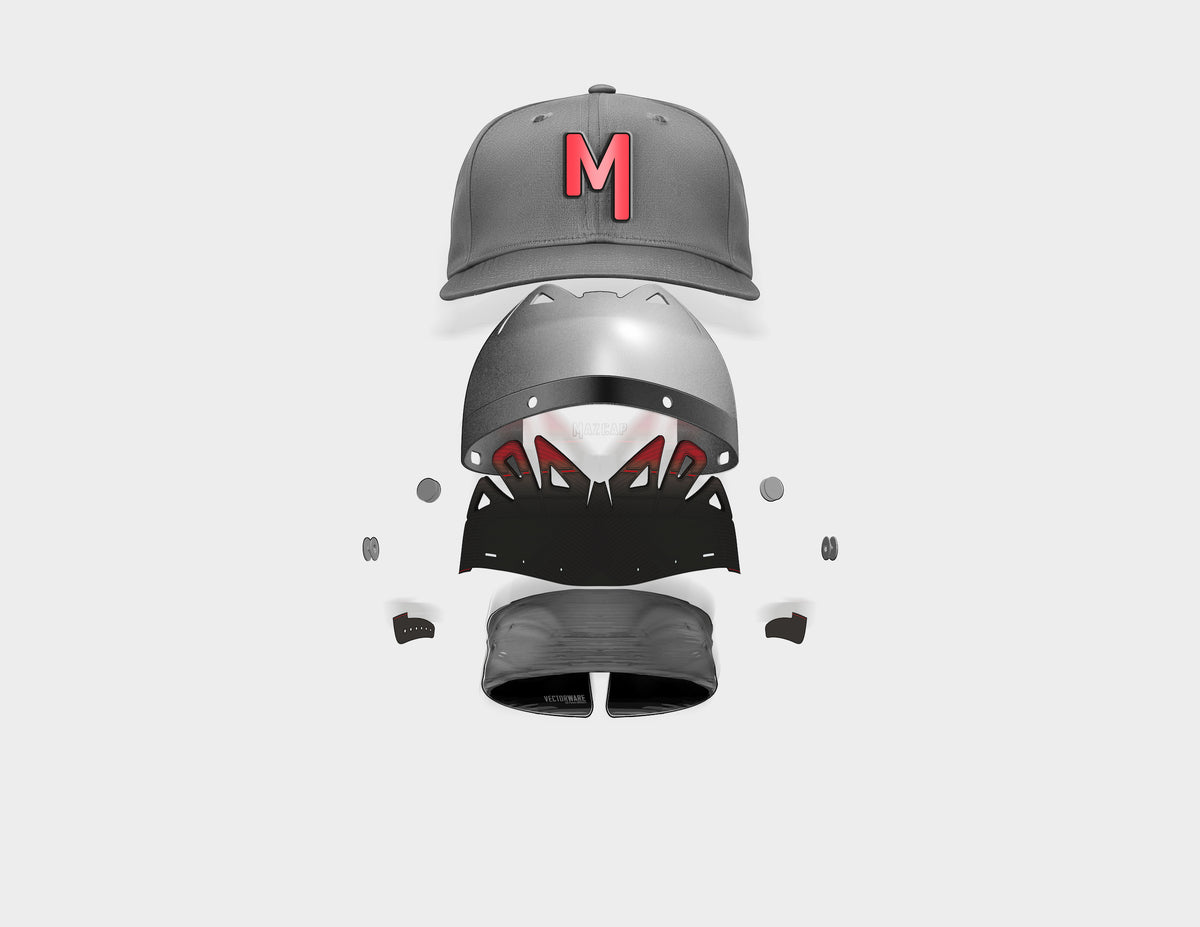
The Energy Management System behind the NOCSAE test results is VECTORWARE, a patented gel-based cushion technology built into the MAZCAP insert. VECTORWARE deforms on impact, redirecting energy away from the collision and reducing the acceleration of the player's head, which is the mechanical property that a Severity Index score is actually measuring. A low SI score isn't a marketing claim on its own. It's the output of a test that records how the head form is accelerated, and a number below 1200 SI means it passed the NOCSAE test which means it offers legitimate risk reduction.
What This Means When You're Buying
A few practical takeaways if you're comparing head protection products for baseball:
- Ask whether the product has faced NOCSAE testing, and by whom.
- Ask for the actual Severity Index score.
- Remember that a passing score is under 1200 SI. Anything higher is a failing result.
- Don't assume padding or thickness alone tells you whether a product passes.
NOCSAE testing exists so claims about head protection can be checked against a real number instead of taken on faith. It doesn't mean a passing product prevents every injury, or makes the game risk free. No product can promise that. What it means is that the product was engineered to pass NOCSAE testing and independently tested to verify it, which is a meaningfully different claim than a product that was never tested at all, or one that failed by a wide margin.
Want to see how MAZCAP is built to pass NOCSAE testing? Pre-order MAZCAP or learn about the VECTORWARE technology behind it on the VECTORWARE page.