Your Cart
-
${ item.product_title }$ ${item.price}

VECTORWARE, A NEW WAY TO MANAGE IMPACTS
VECTORWARE, seen in the adjacent video, is the core technology behind MAZCAP.
Our patented Energy Management System deforms upon impact, redirecting energy and force away from the collision and away from the player’s head. In other words, a significant amount of energy is diverted away from the impact when the cushion deforms reducing the risk of harm.
Acceleration
Severity
Impact
Risk of
Head Injury
VECTORWARE improves safety.
High-speed video of early research testing of VECTORWARE, showing cushion deformation upon impact, happens faster than can be seen with the naked eye. The impact energy dissipates via controlled displacement with an engineered polymer system.
Previous foam-based head protective device that is too thick for wide adoption.
TYPICAL FOAM CUSHIONING HAS A SIZE PROBLEM
Most head protection systems rely on foam compression during impact. This strategy has limited efficacy and requires thicker and thicker foam to reduce risk for high-velocity impacts for pitchers and fielders. This approach makes for big, bulky devices that are less likely to be used especially at higher levels of play.
VECTORWARE ADDRESSES THIS CONSTRAINT
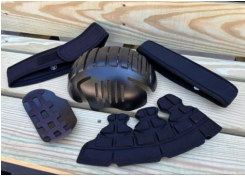
MAZCAP IS THIN – BUT MAKES A BIG DIFFERENCE
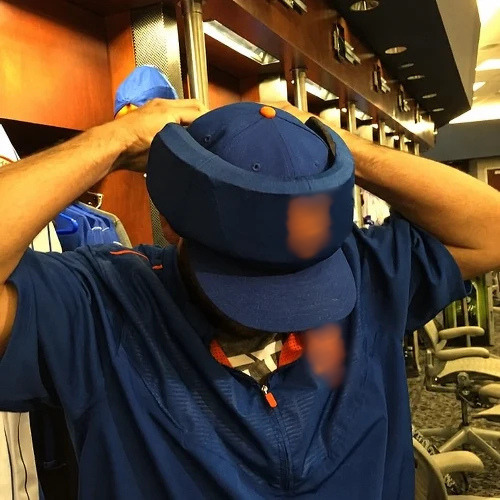
MAZCAP is so efficient at managing energy that it can be thin enough to be hidden under a baseball hat. In other words, you can’t tell the player is wearing protective gear.
A protective device that is inconspicuous and legitimately reduces risk is more likely to be adopted.
MAZCAP REDUCES RISK AND PROTECTS THE TRADITIONAL LOOK OF THE GAME


MEASURING IMPACT SEVERITY IS MORE THAN A FORMULA, IT’S SCIENCE


NOCSAE (National Operating Committee on Standards for Athletic Equipment) is a body that writes standards for athletic equipment for the purpose of reducing the risk of injuries.
Severity Index or SI is the integral calculated from the impact curve (plotted as headform acceleration readings over time) risen to the exponent of 2.5. This impact impulse curve lasts roughly 8 to 10 milliseconds (1 millisecond = 1/1000ᵗʰ of a second). Peak acceleration typically occurs in the first few milliseconds of an impact.
SI is the measurement metric used to define the pass/fail criteria for NOCSAE tests.
A score of <1200 SI is a passing score.
A score >1200 SI is a failing score and represents a high risk for a significant head injury.

Designed With NOCSAE Performance in Mind
MAZCAP was developed the old-fashioned way through experimentation. Research and development spanned many years and thousands of tests until VECTORWARE emerged as a technology capable of passing NOCSAE tests in a thin profile.
The first commercially produced MAZCAPs were tested at an independent, third-party NOCSAE certified lab and all versions passed the NOCSAE test. The adjacent table summarizes the NOCSAE test results for side impacts at ambient conditions.
MAZCAP passes NOCSAE tests and is thin, light, and comfortable enough to be hidden under a cap so a player looks like a traditional ball player.
MEANINGFUL RISK REDUCTION IN A THIN PROFILE

HIDING IN PLAIN SIGHT
Protective gear only helps reduce risk when it is worn. In general, players will not wear big, bulky, unsightly products. Before MAZCAP, thin inserts didn’t offer legitimate risk reduction.
The cool thing is MAZCAP looks great because it is thin enough to be hidden under a baseball cap. You can’t tell a player is wearing protective gear, and at the same time, it offers real risk reduction.
MAZCAP – WORN BUT NOT SEEN